Ahead of the Alarm: Catching an Insulation Fault on a Solar Inverter Unit
How Kavaken detected falling insulation resistance on one inverter unit weeks before it reached the inverter's trip limit.

Ihsancan Ozpoyraz
Head of Growth

How Kavaken detected falling insulation resistance on one inverter unit weeks before it reached the inverter’s trip limit.
An inverter raises an insulation alarm only once resistance falls below its limit. Until then, a developing fault does not appear in the alarm log. This case study shows how Kavaken detected a decline in negative-pole insulation resistance on one inverter unit at a solar plant, traced it to moisture on the negative DC side, and warned of the trips that followed.
The Challenge
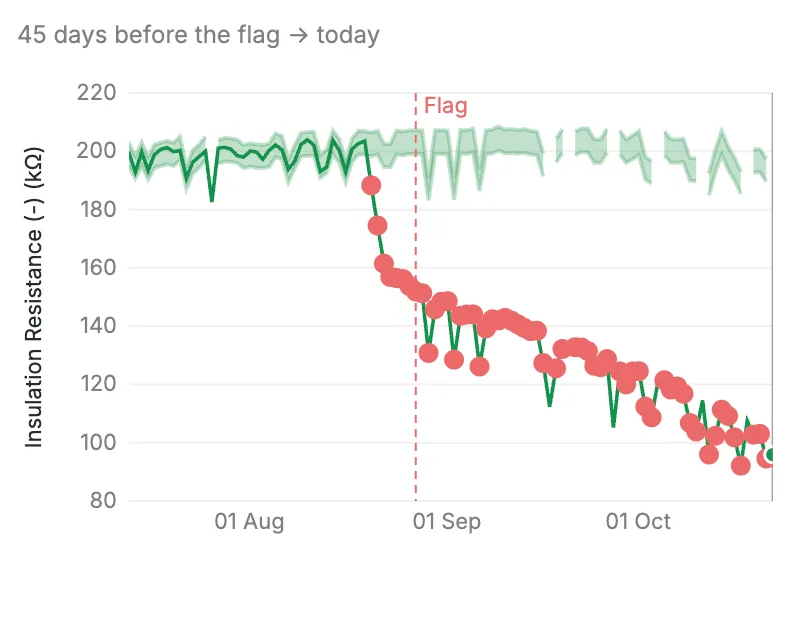
On 22 August 2025, the negative-pole insulation resistance of INV1-UNIT2 at a solar plant dropped sharply, and it kept falling over the following weeks. Output stayed stable. The inverter raised no alarm, because the readings were still above its 50 kΩ limit. Neither the production data nor the alarm log pointed to a problem.
How Kavaken Detected It
Kavaken models the expected insulation resistance of each unit and compares it with similar units at the plant. On 27 August 2025, the Predictive Maintenance module opened a flag on INV1-UNIT2: its negative-pole insulation resistance had dropped well below both its expected value and the other units.
The initial hypothesis was degradation of the insulation path on the negative DC side, or a change in the measurement chain of the negative channel. The recommended actions were to:
- Verify the negative insulation measurement with an independent reference method during a low-production window, recording the positive channel and leakage current at the same time
- If confirmed, plan a targeted inspection of the negative DC connections and cables for moisture, contamination or leakage paths
As the weeks went on, two observations narrowed the cause:
- Only the negative pole was affected. The positive pole stayed at about 225 kΩ and the other units at about 200 kΩ.
- The drop followed the weather. On humid mornings all units dipped, but INV1-UNIT2 dipped much further and only partly recovered on dry days.
Together, these pointed to moisture getting into a connector or junction box on the negative side.
Timeline of Events
- 27 August 2025: Kavaken opened the flag on INV1-UNIT2.
- 2 September 2025: The site team checked the inverter SCADA. The negative-pole insulation resistance read about 130 kΩ during the day and about 80 kΩ early that morning, when the other units dipped to about 140 kΩ. The other units were at about 200 kΩ during the day. There was no insulation alarm, because the inverter’s 50 kΩ limit had not been reached.
- 8 September 2025: As the insulation resistance and leakage current anomalies progressed, Kavaken raised the flag’s risk level.
- 24 September 2025: Kavaken reported that the negative pole had fallen from about 205 kΩ in mid-August to about 130 kΩ. On 17 September it reached 59 kΩ, against about 135 kΩ on the other units. Kavaken identified moisture on the negative side as the likely cause and recommended a string-by-string insulation test before the unit started tripping as the nights became more humid.
- 1 October 2025: Kavaken raised the risk level again.
- 6 October 2025: The site team scheduled a string-by-string insulation test of INV1-UNIT2.
- 22 October 2025: INV1-UNIT2 had its first low-insulation trip. It started producing shortly after sunrise, stopped about 15 minutes later and stayed off for about 75 minutes, with the negative pole at 41 to 49 kΩ. It restarted once the reading reached 50 kΩ and was back above 90 kΩ by 11:30 as the modules dried. With the daytime average down to about 95 kΩ, Kavaken warned that more morning trips were likely and advised that the planned test should go ahead without delay.
What the Data Shows
The negative pole’s daytime insulation resistance fell from about 205 kΩ in mid-August to about 130 kΩ by late September and about 95 kΩ by late October. Over the same period, the positive pole stayed at about 225 kΩ and the other units at about 200 kΩ.
The gap was widest on humid mornings: 59 kΩ against about 135 kΩ on the other units on 17 September, and 41 to 49 kΩ on 22 October, when the unit tripped.
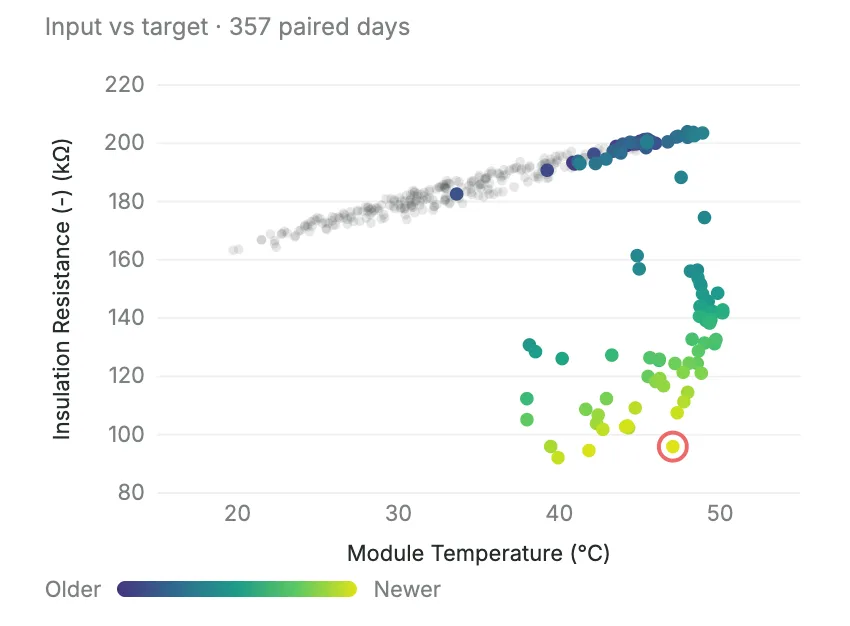
The unit’s own history shows the same break. Normally, its insulation resistance rises with module temperature as the modules dry out, and in its earlier readings INV1-UNIT2 followed that pattern closely. From late August, its readings fell well below that line at the same temperatures, so the drop cannot be explained by operating conditions.
Why It Matters
An inverter’s insulation alarm is a threshold. It says nothing until the limit is crossed, and then the unit stops producing. Tracking insulation resistance against its expected value and against similar units shows the trend weeks before that point, so the inspection can be planned in a low-production window rather than after repeated trips.
Kavaken’s role was to make that fault visible and actionable:
- Detect a decline the inverter’s own alarm could not yet see
- Narrow the cause to moisture on the negative DC side, from the pole comparison and the weather pattern
- Anticipate the trips as humid nights became more frequent
- Prioritise the inspection by raising the risk level as the fault progressed
Conclusion
Kavaken detected the insulation decline on INV1-UNIT2 weeks before the inverter’s limit was reached, narrowed it to moisture on the negative DC side, and warned that morning trips would follow. The first trip came on 22 October, and the site team scheduled a string-by-string insulation test of the unit.


